
7 Reasons Your 4x4 Overheats During Rock Crawling

Last Updated: October 24, 2026
Quick Summary
4x4 overheating during rock crawling happens because crawling combines high engine load with almost no airflow, so the radiator relies entirely on a fan that may be slipping. A failed fan clutch is the most common low-speed culprit, though transmission heat and low coolant can also be the source.
- Check the fan clutch cold for resistance and hot for lock-up and roar.
- Mud packed into the radiator fins is the silent killer, so clean the core after every muddy trip.
- Transmission heat can dump into engine coolant through the radiator, so check fluid color and smell.
- Never pour cold water on a hot engine block or radiator, as thermal shock can crack cast iron.
- Flush and refill coolant every 30,000 to 60,000 miles, but check your owner's manual.
Table of Contents
- Why Your 4x4 Overheats During Rock Crawling
- 4x4 Overheating at Low Speed: The Airflow Problem
- Coolant Level, Condition, and Leaks
- Bad Thermostat or Water Pump Symptoms
- Separating Engine Heat From Transmission Temperature
- Trailside Overheating Troubleshooting: What to Do First
- How to Prevent 4x4 Overheating on the Trail
- Book a Free Cooling-System Inspection Before Your Next Crawl
- Frequently Asked Questions
Why Your 4x4 Overheats During Rock Crawling
Your rig ran cool all morning on the highway. Then you dropped into low range, started creeping over boulders, and the temperature gauge climbed into the danger zone. 4x4 overheating during rock crawling is almost never a random failure.
Here's the core problem: crawling combines high engine load with almost no airflow. At Unlimited Offroad, we've spent over 20 years watching this exact scenario play out on trail rigs, and the diagnosis usually follows a short list of suspects.
Below, we'll walk through the seven reasons your 4x4 overheats during rock crawling, in the order we'd actually check them. The first one is the one most owners never think about.
4x4 Overheating at Low Speed: The Airflow Problem
4x4 overheating at low speed comes down to one thing: the radiator needs air, and crawling gives it none. A mechanical fan pulls air through the radiator at idle, but only if the fan clutch is engaging properly.
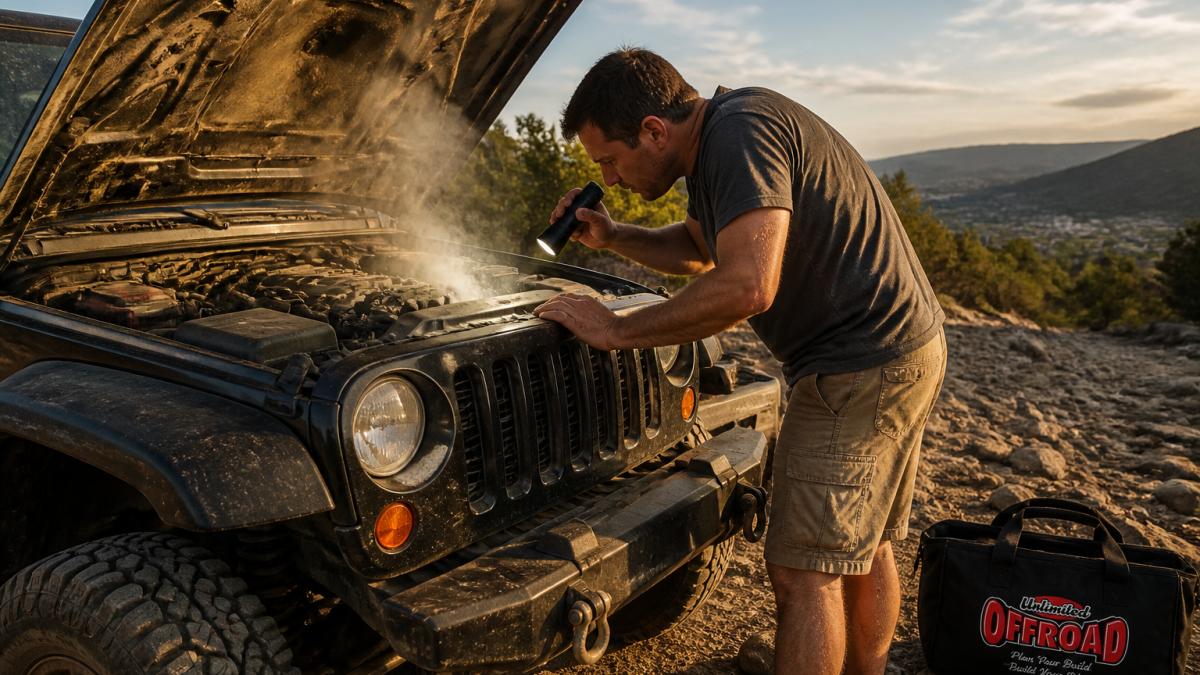
That's why a rig that runs perfectly at highway speed can boil over on the rocks. Engine load goes up, coolant temperature rises, and the only thing moving air is a fan that may be slipping.
Fan Clutch and Mechanical Fan Checks
A failed fan clutch is the most common low-speed overheating culprit we see. When the clutch stops locking up, the fan free-spins and moves almost no air.
Check it cold: the fan should turn with some resistance. Check it hot: it should lock and roar. If it spins freely when hot, replace it.
- Look for cracked or missing fan blades
- Check the fan shroud is intact and sealed to the radiator
- Confirm the fan sits close enough to the core to pull air effectively
Coolant Level, Condition, and Leaks
Low coolant is the simplest explanation, so rule it out first. Pop the hood while the engine is cold and check the overflow bottle and the radiator itself.
Condition matters as much as level. Coolant that looks rusty or muddy has lost its corrosion protection and can clog the radiator. Look for:
- White crust or residue around hose clamps
- Puddles under the water pump weep hole
- Swollen or soft radiator hoses
A common mistake is topping off with straight water on the trail. That's fine to get home, but it dilutes the mix and lowers the boiling point. Flush and refill with the correct mix once you're back.
Bad Thermostat or Water Pump Symptoms
Bad thermostat or water pump symptoms show up as temperature swings, poor heater performance, or a gauge that climbs and won't come back down. A sticking thermostat can stay closed and block coolant flow entirely.
A water pump on its way out often gives you a warning first:
- A weeping seal or coolant trail from the pump
- A grinding or whining noise from the front of the engine
- The heater blowing cold at idle even when the engine is warm
If the heater goes cold when you're idling on an obstacle, pay attention. That's a circulation problem, not a fan problem.
Radiator Cap and Radiator Condition
The radiator cap is a cheap part that causes expensive problems. It holds system pressure, and pressure raises the boiling point. A weak cap lets coolant boil early.
Check the radiator itself for bent fins, mud packed into the core, and debris from the last trail ride. Crawling throws mud and dust into the grille, and a clogged core can't shed heat no matter how good the fan is.
Separating Engine Heat From Transmission Temperature
Here's the angle most guides skip: not every hot gauge is an engine problem. Rock crawling works the transmission hard. Low range, constant torque converter slip, and stop-and-go crawling build serious heat in the transmission fluid.
The tricky part is that most rigs don't have a transmission temperature gauge from the factory. So you have to diagnose by feel, smell, and behavior. Here's how to tell which system is actually overheating.
Clues That Point to Transmission Heat
- The engine temp climbs slowly and steadily on long, low-speed climbs, not in sudden spikes
- The gauge drops quickly when you stop and idle in neutral, even before the fan has time to catch up
- You smell a burnt, acrid odor that isn't quite coolant, transmission fluid has a distinct sharp smell
Clues That Point to Engine Heat
- The gauge spikes fast under load and stays high even at idle
- The heater blows cold at idle, which points to coolant circulation
- You see steam or smell coolant
What to Check Next
If you suspect transmission heat, check the fluid. Pull the dipstick (if equipped) and look at the color. Healthy transmission fluid is reddish and translucent.
If the transmission fluid looks and smells fine, move to the engine side. Check the fan clutch, thermostat, and radiator cap as outlined above.
A common pattern is that owners throw a new radiator at a rig that actually needs a transmission cooler. Don't be that guy. Diagnose the source before you start swapping parts.
Use these clues to tell which system is actually running hot before you start swapping parts.
| Clue | Points to transmission heat | Points to engine heat |
|---|---|---|
| Gauge behavior | Climbs slowly and steadily on long low-speed climbs | Spikes fast under load and stays high at idle |
| Idle response | Drops quickly when idling in neutral | Stays high even at idle |
| Smell | Burnt, acrid odor that isn't quite coolant | Steam or coolant smell |
| Heater | Not a listed clue | Blows cold at idle |
| Fan | Not a listed clue | Roars constantly but temp won't drop |
| Radiator or hose | Not a listed clue | Radiator cold on one side or upper hose cold |
| Transmission behavior | Shifts harshly or slips when hot | Not a listed clue |
| Fluid check | Dark brown or black fluid with burnt smell | Fluid looks and smells fine |
Trailside Overheating Troubleshooting: What to Do First
Trailside overheating troubleshooting follows a strict order. Get safe, then diagnose. Here's the sequence we'd run:
- Pull over and shut it down. Don't open the hood into your face on a hot system.
- Let it cool before touching the cap. Pressure and steam can burn you badly.
- Check coolant level once it's cool enough to open safely.
- Look for leaks at hoses, the water pump, and the radiator.
- Check the fan for free-spin when hot.
- Inspect the radiator core for mud and debris.
- Restart and watch the gauge at idle before you move again.
Watch out: never pour cold water on a hot engine block or radiator. Thermal shock can crack cast iron and warp aluminum heads. Let it cool naturally.
If you're stuck on the trail with a rig that won't stay cool, that's a job for a shop that knows off-road builds, not a roadside guess.
How to Prevent 4x4 Overheating on the Trail
How to prevent 4x4 overheating starts before you leave the driveway, but the trail-side habits matter just as much. Preventive maintenance beats trailside repairs every time, and driving technique is free.
Maintenance That Actually Matters
- Flush and refill coolant on schedule, most manufacturers recommend every 30,000 to 60,000 miles, but check your owner's manual
- Replace the thermostat and radiator cap as routine wear items every few years, even if they seem fine
- Clean the radiator core after every muddy trip, mud packed into the fins is the silent killer
Driving Technique That Keeps You Cool
Rock crawling is hard on the cooling system because you're asking for maximum torque at minimum speed. A few habits make a big difference:
- Pick clean lines. Avoid unnecessary wheel spin and throttle jabs. Every time you stab the throttle to bump over an obstacle, you're adding heat.
- Don't sit and idle against an obstacle. If you're bound up, back off and reset. Drivetrain binding under load builds heat fast, and backing off saves both your axles and your cooling system.
- Use low range properly. Crawling in low range keeps engine RPM down and torque multiplication up, which actually reduces heat compared to trying to finesse an obstacle in high range.
When to Stop, Idle, or Shut Down
If the temperature gauge climbs into the warning zone, don't ignore it. Here's the sequence:
- Pull over safely and shut off the engine if the gauge is pegged or you see steam.
- Let it cool before opening the hood or touching the cap. Pressure and steam can burn you badly.
- Check coolant level once it's cool enough to open safely.
- Look for leaks at hoses, the water pump, and the radiator.
- Check the fan for free-spin when hot.
- Inspect the radiator core for mud and debris.
- Restart and watch the gauge at idle before you move again.
If you're stuck on the trail with a rig that won't stay cool, that's a job for a shop that knows off-road builds, not a roadside guess. But most overheating problems are preventable with the right habits and a little attention to the gauges.
Book a Free Cooling-System Inspection Before Your Next Crawl
Cooling problems don't fix themselves, and a rig that overheats on the trail is a rig that's one bad climb from a tow.
At Unlimited Offroad, our team has spent over 20 years building and repairing trail rigs, and we know exactly where 4x4 overheating hides.
Get started with Unlimited Offroad and hit the rocks with a cooling system you can trust.
Frequently Asked Questions
Why does my 4x4 overheat when crawling slowly?
Crawling combines high engine load with almost no airflow through the radiator. At 2 mph, the fan has to do all the work, and if the fan clutch is weak or the radiator is packed with mud, it can't keep up. Low range also multiplies torque through the drivetrain, which adds heat from the transmission and transfer case. Check fan operation, clean the radiator fins, and confirm coolant level before blaming the engine itself.
How can I tell if a bad thermostat or water pump is causing overheating?
A stuck-closed thermostat usually shows up as a temperature gauge that climbs fast and never drops, with a cold lower radiator hose. A failing water pump often brings a coolant weep at the weep hole, a squealing belt, or a heater that blows cold at idle. If the gauge swings wildly or the heater performance changes with rpm, those are classic bad thermostat or water pump symptoms worth checking before a trail day.
What should I do if my 4x4 overheats on the trail?
Pull off the line, shut the engine off, and let it cool before touching anything. Never open the radiator cap while hot. Once it cools, check coolant level, look for leaks at hoses and the radiator, and inspect the fan and belt. If you can't find the cause, air down, pick the easiest line back, and limp out in low range with the heater on full blast to pull heat off the engine.
Can a winch or grille accessory make a 4x4 overheat?
Yes. A winch, light bar, or aftermarket bumper can block airflow to the radiator, especially at crawling speeds where there's no ram air to compensate. If you added accessories and then noticed 4x4 overheating at low speed, that's a likely culprit. Relocating the winch control box, trimming the grille insert, or adding a vented hood can restore airflow without losing the gear you want.
